
Garage Door Repair: Repair or Replace? How Brentwood Homeowners Decide
Here’s the test that actually matters: does the repair cost less than the remaining life of the door? A 15-year-old door with a snapped spring usually passes that test easily – you replace a worn spring and get years of service out of a structure that’s still sound. A 7-year-old door with a cracked bottom panel on a line the manufacturer stopped making can fail it, even though it’s half the age. Brentwood homeowners ask us this question constantly, and the honest answer almost never starts with “how old is it?” It starts with what broke, whether parts still exist, and what repair actually buys you.
If you’d rather have someone look at the specific failure than work through the math alone, call (833) 348-8658. We answer 24/7. Fast dispatch from 7am to 7pm, Sunday through Friday.
Why age is the wrong place to start
We’ve talked to plenty of Brentwood homeowners who were told their door was “getting up there” and should be replaced. Sometimes that’s true. Often it’s a sales pitch wearing a technician’s shirt. The number on the door’s install date tells you less about its future than three other things: what just failed, whether you can still buy that part, and how much you’ve already spent keeping it running.
A single failed component on an otherwise healthy door is almost always a repair. Springs, cables, rollers, hinges and openers are wear items. They’re supposed to fail and get replaced. The door itself – the panels, the frame, the track – is the part with real longevity, and if that structure is straight and solid, replacing it because a torsion spring let go is like buying a new car because the brakes wore out.
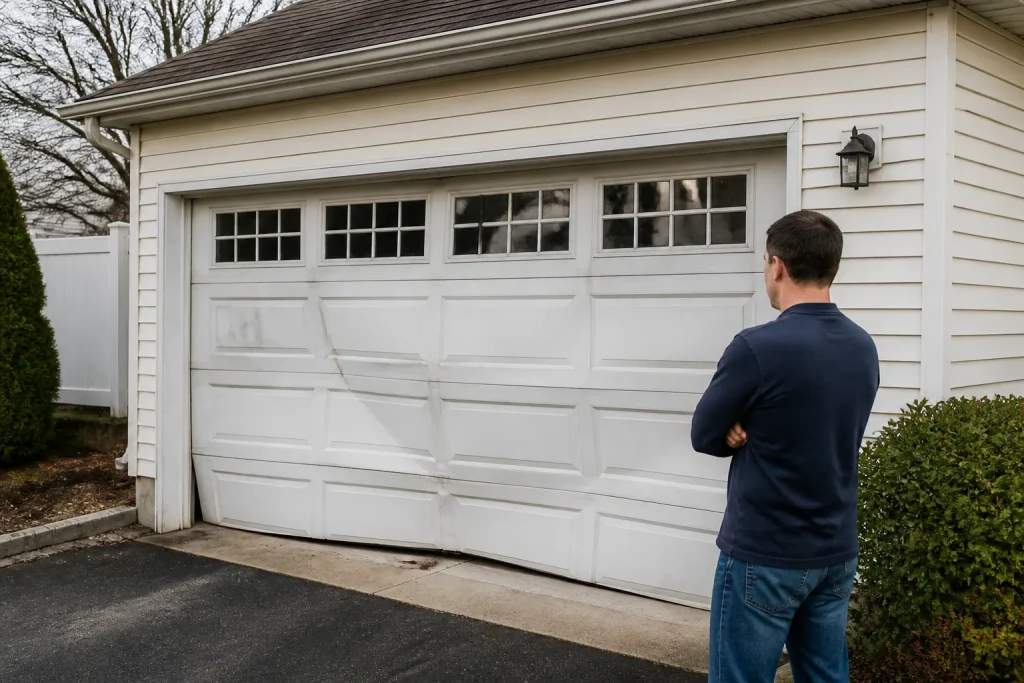
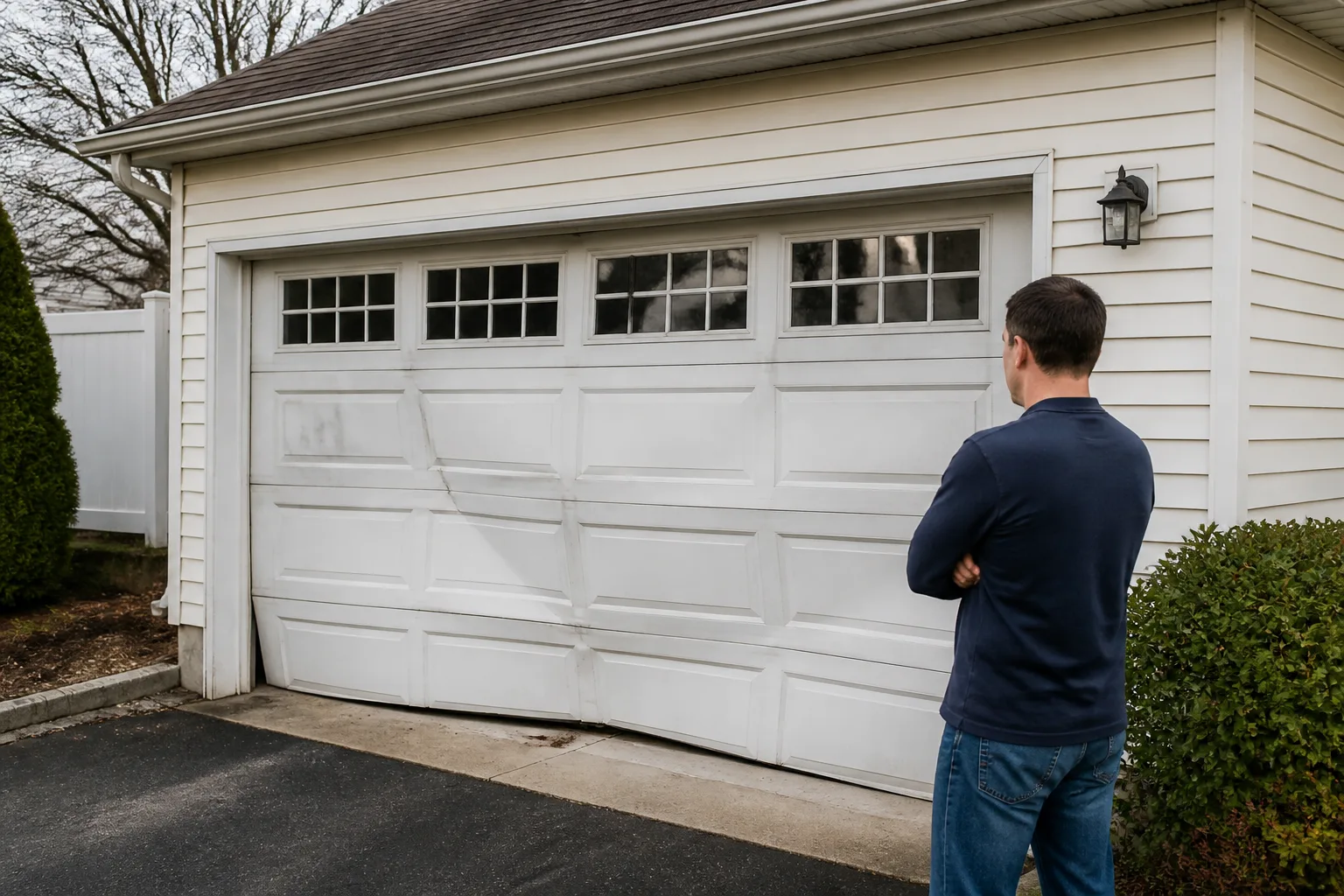
The picture flips when the failure is structural or the parts pipeline has dried up. A cracked panel on a discontinued door line is a different problem entirely, because the repair you need may not exist anymore. That’s when the decision genuinely gets harder, and it’s where the framework below earns its keep. In our experience across Brentwood, the doors that catch homeowners off guard are the ones that look fine but sit on product lines the manufacturer has already retired.
The cost-per-year test: the math most quotes skip
Here’s the formula we’d use if it were our own door: divide the repair cost by the number of years the repair realistically adds, then compare that to the annualized cost of a new door spread over its expected life. The lower number wins. It’s simple arithmetic, and it cuts through most of the hand-waving.
Run it on typical Brentwood jobs and the pattern gets clear. A spring replacement that costs a few hundred dollars and keeps the door working for several more years has a low annualized cost – a strong repair case. A string of smaller failures adding up to a large share of a new door’s price, spread over a door that’s already near the end of its practical life, trends toward replacement. The repair isn’t wrong in that second case; it’s just expensive relative to what it buys.
- One wear item, sound door: repair wins on cost-per-year almost every time.
- Two or three failures in a short span: start asking whether you’re chasing a door that’s failing system by system.
- Repair cost approaching a meaningful fraction of replacement: the math tilts toward a new door, especially if the structure is tired too.
- Repair that only postpones the same expense a year or two out: you’re paying twice for one outcome.
The point isn’t a magic dollar threshold. It’s that you deserve the arithmetic laid out, not a gut feeling dressed up as expertise. A repair that extends real value is worth doing. A repair that just delays an inevitable replacement is a bill with a delay attached, and you should see that clearly before you agree to it.
Parts availability: the decision trigger nobody mentions
Before you decide anything, find out whether your door’s panels, springs and weatherseal are still manufactured. That single question changes the economics more than age does, because a repair is only a repair if the parts exist. A discontinued panel or a proprietary track profile can turn a routine fix into a fabrication problem, and fabrication is where repair costs climb toward replacement territory.
How do you find out? Look for the manufacturer’s label or sticker inside the door or on the end stile, note the model, and ask a specialist who works your brand whether that line is still in production. This is exactly where factory-brand fluency matters. We work on Wayne Dalton, Craftsman, Raynor and LiftMaster systems, among others, and knowing a specific line’s status – current, revised, or retired – is the difference between a straight answer and a shrug. A technician who services your brand regularly can tell you in minutes whether the part you need is a phone call away or no longer made.
What discontinued status means for the math: if the panel that cracked is out of production, a like-for-like repair may not be possible, and patching around it can look cosmetically mismatched and function poorly. Springs and weatherseal are usually more forgiving, since many are matched by dimension rather than by exact model. Panels are the hard stop. When the panel is gone, replacement often becomes the honest recommendation, and you should hear that reasoning out loud rather than as a nudge toward the showroom.
The five conditions where replacement is the right financial call
Sometimes new is simply correct, and we’ll say so. Replacement is the objective choice when one or more of these five conditions is true, regardless of how cheap the immediate repair looks:
- The panel or structural part is discontinued and no compatible replacement exists, so repair can’t fully restore the door.
- Cumulative repair cost is climbing toward a large share of a new door’s price over a short window – you’re paying for a replacement in installments without getting one.
- The structure is compromised – bent track, sagging sections, a door that’s been repeatedly knocked off its guides – and repairs would be chasing damage rather than fixing it.
- Safety hardware can’t be brought up to standard on an older door without rebuilding most of it, which tips the cost-per-year math toward new.
- You’re planning to sell and a tired door is dragging down curb appeal and the inspection conversation, so the replacement earns back part of its cost at resale.
Notice what’s not on that list: age by itself. A well-built door that’s older than you’d guess can still be a smart repair if its parts are available and its structure is sound. And a newer door can be a replacement candidate if it’s on a retired line with a cracked panel. Brentwood homes run the full range of door ages, and the condition list applies to all of them equally.
Insulation, energy code and resale: the replacement-side factors
If you’re leaning toward replacement anyway, factor in what a new door gives you beyond the repair. Insulation value is the big one for an attached garage, especially where the garage shares a wall with living space. A properly insulated door holds heat in winter and keeps the garage cooler in summer, and that has a real effect on the rooms next to it. If your current door is a thin, uninsulated model, part of the replacement cost is buying comfort you don’t have now.
Energy code compliance is worth a question to your town’s building department when you’re pricing a new door, since requirements can vary and the department is the authority on what applies to your project. We won’t quote you a code section we haven’t confirmed – ask the department directly and get it in writing for your records.
On resale, a garage door is one of the most visible features of a Brentwood house from the street, and buyers notice a dented, misaligned or dated door before they notice much else. A replacement that lifts curb appeal can earn back part of its cost when you sell, which belongs on the replacement side of your ledger. A repair that keeps a sound door working doesn’t carry that resale bump, but it also costs far less up front. Both are legitimate; the question is which fits your plans.
What a real assessment sounds like versus a sales pitch
A credible recommendation comes with reasoning you can check. A sales pitch comes with urgency you can’t. The difference shows up in the language and the documentation, and once you know what to listen for, it’s hard to miss.
A real assessment shows you the failed part, explains what it does, and tells you whether it’s a wear item or a structural one. It states whether your door’s line is still in production. It gives you a written estimate with the repair priced line by line, and it tells you the cost-per-year reasoning in plain terms. It’s comfortable saying “this is a repair” when that’s the truth – a specialist who only sells new doors has a conflict of interest, and you should weigh that. It also doesn’t pressure you to decide on the spot; the written estimate is the price, and the price is quoted and agreed before any work starts.
A sales pitch leans on the door’s age, skips the parts-availability question, bundles in upgrades you didn’t ask about, and treats “replace” as the only serious option. When a recommendation arrives that way, ask the two questions that separate the two: “Is my door’s line still manufactured?” and “What does the repair cost per year compared to a new door?” A straight answer to both tells you which conversation you’re in.
When to call a pro: springs, cables and anything involving the door’s balance system are genuinely dangerous to touch, and we don’t recommend DIY on them. A trained specialist with the right tools handles that work safely. For the parts-availability question and the cost-per-year math on your specific door, a professional assessment is worth more than any checklist. You can read more about our garage door spring repair and our garage door repair work, or dig into garage door opener repair if the opener is what’s failing. Our technicians have up to 9 years of experience, and we work the brands your door was built with.
Related services in Brentwood: spring repair, opener repair, and full installation – one call covers repair, opener, springs, or a full new door, so you never need a second company. If you’d rather not sort through the decision alone, Brentwood Garage Door Repair Pros is here to walk the math with you.
The Bottom Line
Repair or replace in Brentwood comes down to parts availability and cost-per-year, not the door’s age. A single wear-item failure on a sound, still-supported door is a repair. A discontinued panel, a compromised structure, or a pile of repairs approaching replacement cost is a replacement. Get the parts question answered first, run the arithmetic second, and insist on a written estimate before anything starts. Our technicians have up to 9 years of experience, and we’ll tell you plainly which side of the line your door falls on.
If you’re in Brentwood and need help, Brentwood Garage Door Repair Pros offers free estimates – call (833) 348-8658. We answer 24/7. Fast dispatch from 7am to 7pm, Sunday through Friday. Same-day repair is available for urgent failures, and for a new door we’ll schedule a free measure and a written price. Either way, the price is quoted and agreed before any work starts.
Frequently Asked Questions
Start with parts availability, then run the cost-per-year math. If your door’s panels and springs are still manufactured and the structure is sound, a repair on a failed wear item is almost always the right call. If the part is discontinued or repair cost is approaching a large share of a new door’s price, replacement is the honest recommendation. Call (833) 348-8658 for a free estimate and we’ll walk through both numbers with you.
Usually yes, if its parts are still available and the panels and track are sound. Age alone doesn’t decide it – a well-built door with a failed spring is a repair, not a replacement. The cost-per-year test settles it: divide the repair cost by the years it adds and compare that to a new door spread over its life. Call (833) 348-8658 and we’ll run that math for your specific door.
It means the exact panel or structural part may no longer be made, which can make a like-for-like repair impossible. Springs and weatherseal are often matched by dimension and remain repairable, but a discontinued panel is the hard stop that often tips the decision toward replacement. A specialist who works your brand can confirm your line’s status quickly. Call (833) 348-8658 for a free assessment.
No. The written estimate sets the price, and it’s quoted and agreed before any work starts. We inspect the door, identify the failure, check parts availability, and give you the number in writing – what you agree to is what you pay. If the scope genuinely changes once work begins, we tell you before proceeding, never after. Call (833) 348-8658 for a free estimate.
Written by the team at Brentwood Garage Door Repair Pros.
Need Garage Door Help?
Call Brentwood Garage Door Repair Pros - the local pro we connect you with is licensed and insured, here with fast help in Brentwood.
(833) 348-8658