
Genie Garage Door Repair in Brentwood: A Homeowner’s Guide
Most homeowners in Brentwood never open the manual that came with their Genie opener – and on newer models, there’s no paper manual in the box at all. So when the LED on the motor head starts blinking, the door does nothing, and the wall button seems dead, people assume the worst and start pricing new openers. Here’s the truth: that blinking light is a diagnostic message. It’s telling you exactly what’s wrong. This guide decodes it, explains the Genie-specific failure patterns we see in Brentwood, and helps you describe the problem accurately before you call anyone – or spot when a technician is guessing.
If you’d rather skip the detective work and get it fixed, call (833) 348-8658. We answer 24/7. Fast dispatch from 7am to 7pm, Sunday through Friday, and the estimate is free.
Key Takeaways
- Genie LED blink codes follow a count-and-pause pattern: the number of blinks before the pause points to the specific fault.
- SilentMax DC-motor openers can develop speed inconsistency after years of use – and it’s often not a failing motor.
- Most Intellicode remote pairing failures are solved by a two-step reset that clears old codes before re-pairing.
- Genie safety sensor alignment differs from LiftMaster’s, so cross-brand troubleshooting causes repeat service calls.
- Some Genie parts are stocked locally; others require ordering. Knowing which is which matters when your door is stuck open.
What do the blinking LED codes on a Genie opener mean?
A blinking LED on a Genie opener is a fault code, not a warning that the unit is dying. The light blinks a set number of times, pauses, then repeats. Count the blinks in one cycle and you have the fault category: typically an obstruction or sensor issue, a travel-limit problem, a logic board fault, or a motor/force fault. The pattern repeats for as long as the fault exists, so you can watch it more than once to confirm the count.
Where homeowners get stuck is that newer Genie openers often ship with a quick-start card instead of a full manual, and the code chart lives in the full document. Here’s how to work around that:
- Count the blinks in one burst. Watch for the pause, then count the next burst to confirm the pattern is consistent.
- Find the model number on the motor head label (SilentMax, ChainMax, and Excelerator units each label it clearly) and look up that model’s code chart.
- Write the count down before you call anyone. A technician who hears “it blinks four times, pauses, then blinks four again” can often bring the right part on the first visit instead of diagnosing twice.
The three Genie lines we see most in Brentwood are the SilentMax 1200, the ChainMax 500, and the Excelerator. Their code charts aren’t identical, so the model number matters. A code on one line can point to a different component than the same count on another.
If the blinking stops and the door works again after you clear an obstruction, you’ve diagnosed and fixed it yourself. If the code returns with nothing in the door’s path, that’s a real fault. For that, our garage door opener repair team works on Genie equipment every week.
Why does my Genie SilentMax door move at inconsistent speeds?
A Genie SilentMax that suddenly lurches, slows mid-travel, or reverses at random after several years of service is usually not suffering from a “bad motor.” The DC motor in the SilentMax line is one of the more durable parts of the unit. What actually wears is everything around it: the travel limits drift, the force settings fall out of calibration, the logic board’s speed sensing gets confused by a binding door, or the door itself has developed friction that the opener is fighting.
In our experience, the misdiagnosis is common. A homeowner or a generalist technician hears the inconsistent movement, assumes the motor is failing, and quotes a full opener replacement. That’s an expensive fix for a problem that often lives in the door’s hardware or the opener’s calibration.
What a proper SilentMax diagnosis checks, in order:
- Door balance. Disconnect the opener and lift the door by hand. A balanced door stays put at mid-travel. A door that slams down or refuses to lift has a spring or roller problem, not an opener problem.
- Travel limits and force settings. These drift with use and temperature swings. Recalibrating them is a routine adjustment, not a part.
- Logic board speed sensing. If the door moves freely and the limits are set, the board’s sensing circuit is the next suspect.
- The motor itself. Only after the above checks out does the motor become the likely cause.
This is exactly the kind of model-specific pattern that generic repair advice misses. If your SilentMax is behaving badly, describe the symptom precisely – when it lurches, whether it’s on the way up or down, and whether it happens cold or after several cycles.
How do I fix Genie Intellicode remote pairing problems?
Genie Intellicode remotes that refuse to pair are usually not broken. The fix in most cases is a two-step reset that clears old codes from the opener’s memory before the new remote is paired – and skipping that step is the single most common reason pairing fails on the first, second, and third try.
The two-step approach:
- Clear the opener’s memory first. Depending on the model, this is a long press on the learn button until the LED changes, or a specific press sequence. This erases every previously paired remote and keypad.
- Pair the remote fresh. Press the learn button once, then press and hold the remote button within the pairing window. The opener acknowledges with a blink or a click, and the remote is paired.
The second failure mode is Intellicode version mismatch. Genie has used more than one Intellicode generation, and a remote from a different generation won’t pair no matter how many times you try. The remote’s model number tells you which generation it is. If the opener is older and the remote is newer, or the reverse, the fix is matching components – not a new opener.
A third, quieter cause: a weak battery in the remote reads as a pairing failure because the signal never reaches the opener during the pairing window. Swap the battery before you conclude the remote is defective. It sounds obvious, and it is – right up until you’ve spent an hour on the ladder.
If you’ve cleared the memory, matched the Intellicode generation, swapped the battery, and the remote still won’t pair, the receiver board in the opener is the remaining suspect. That’s a component-level repair, and it’s where a specialist saves you time.
Are Genie parts actually available locally in Brentwood, or do I have to wait?
Parts availability is the question most repair guides skip, and it matters most when your door is stuck open and your house isn’t secure. The honest answer is that it depends on the part. Genie is one of the most widely supported opener brands, so common wear items are usually within reach quickly. Less common components – specific logic boards, older receiver modules, certain SilentMax motor assemblies – may need to be ordered.
What falls on each side, generally:
- Usually quick to source: remotes, keypads, safety sensors, gears, capacitors, and common opener hardware.
- Sometimes requires ordering: logic boards for specific model revisions, receiver modules for older Intellicode generations, and motor assemblies for discontinued lines.
For emergency planning, the practical step is giving whoever you call the model number and the blink code up front. A technician who knows the model and the symptom can tell you before arriving whether the fix is likely to be a stocked part or an ordered one – which changes how you plan for a door that won’t close. This is where the specialists, not generalists, distinction matters: a company whose entire focus is garage doors knows the Genie part landscape and can tell you what to expect instead of discovering it mid-repair.
If your door is stuck and you’re in Brentwood, call (833) 348-8658. We answer 24/7. A call outside dispatch hours is booked into the next opening, Sunday through Friday, 7am to 7pm, so you’ll know where you stand.
Why does cross-brand advice fail on Genie safety sensors?
Genie safety reversal sensors align differently from LiftMaster’s, and this is where a lot of well-meaning advice goes wrong. A homeowner who follows a LiftMaster sensor guide on a Genie opener can get the door working briefly, then watch it fail again days later – and conclude the opener is unreliable when the real problem is a sensor alignment that was never correct to begin with.
The key differences:
- Mounting and adjustment. Genie sensors have their own bracket geometry and alignment method. Forcing them into a LiftMaster-style setup leaves them marginally aligned, and marginal alignment fails as the door vibrates and the seasons change.
- Indicator behavior. The LED behavior on Genie sensors differs from other brands. A steady light on one and a blinking light on the other means something different on Genie equipment than it does on other systems.
- Wiring and polarity. Sensor wiring terminals and polarity conventions vary by brand. A cross-wired sensor can behave intermittently in ways that look like a failing opener.
When a sensor issue keeps coming back after a “fix,” the likely explanation is brand-mismatched troubleshooting. The solution isn’t a new sensor or a new opener – it’s aligning the Genie sensor to Genie’s own spec. This is one of the reasons we work on the specific brands we do. Our technicians have up to 9 years of experience and are certified on Genie, LiftMaster, Chamberlain, and Clopay equipment, so the advice matches the machine.
When to call a pro
Some Genie problems are genuinely DIY: a remote that needs re-pairing, a sensor that’s been bumped out of alignment and can be reset with nothing more than a careful adjustment, a battery swap. If you’ve decoded the blink code, checked the obvious obstructions, and the door is working, you’ve saved yourself a service call.
Call a technician when:
- The LED code returns with nothing in the door’s path.
- The door moves erratically, reverses at random, or lurches.
- A spring looks stretched, broken, or the door is suddenly very heavy.
- A sensor issue keeps coming back after adjustment.
- The door hangs off its track or is visibly out of alignment.
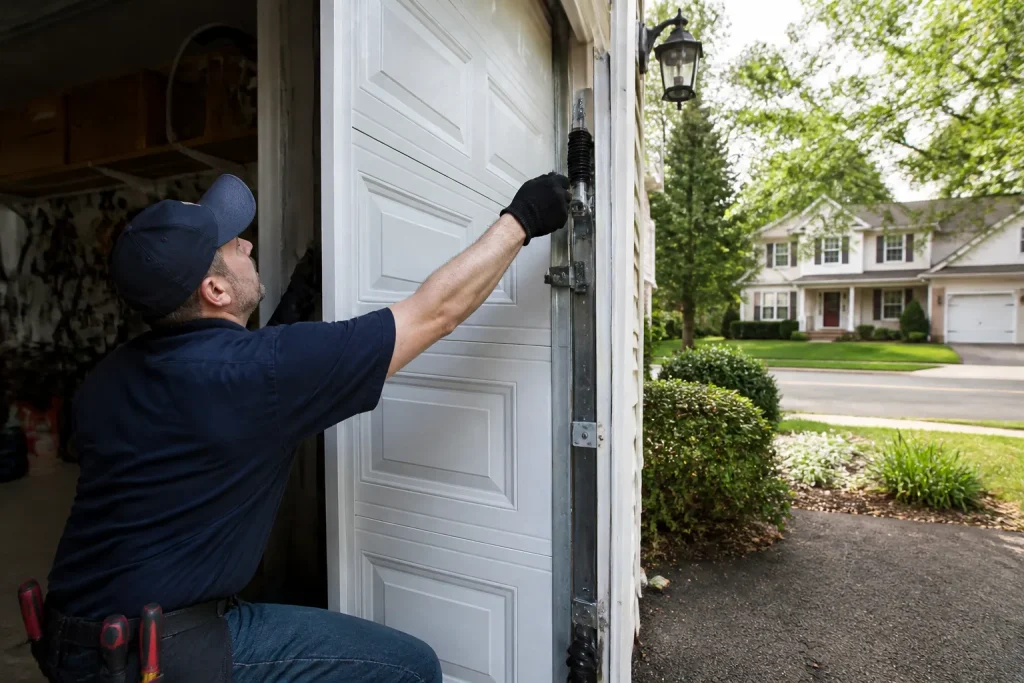
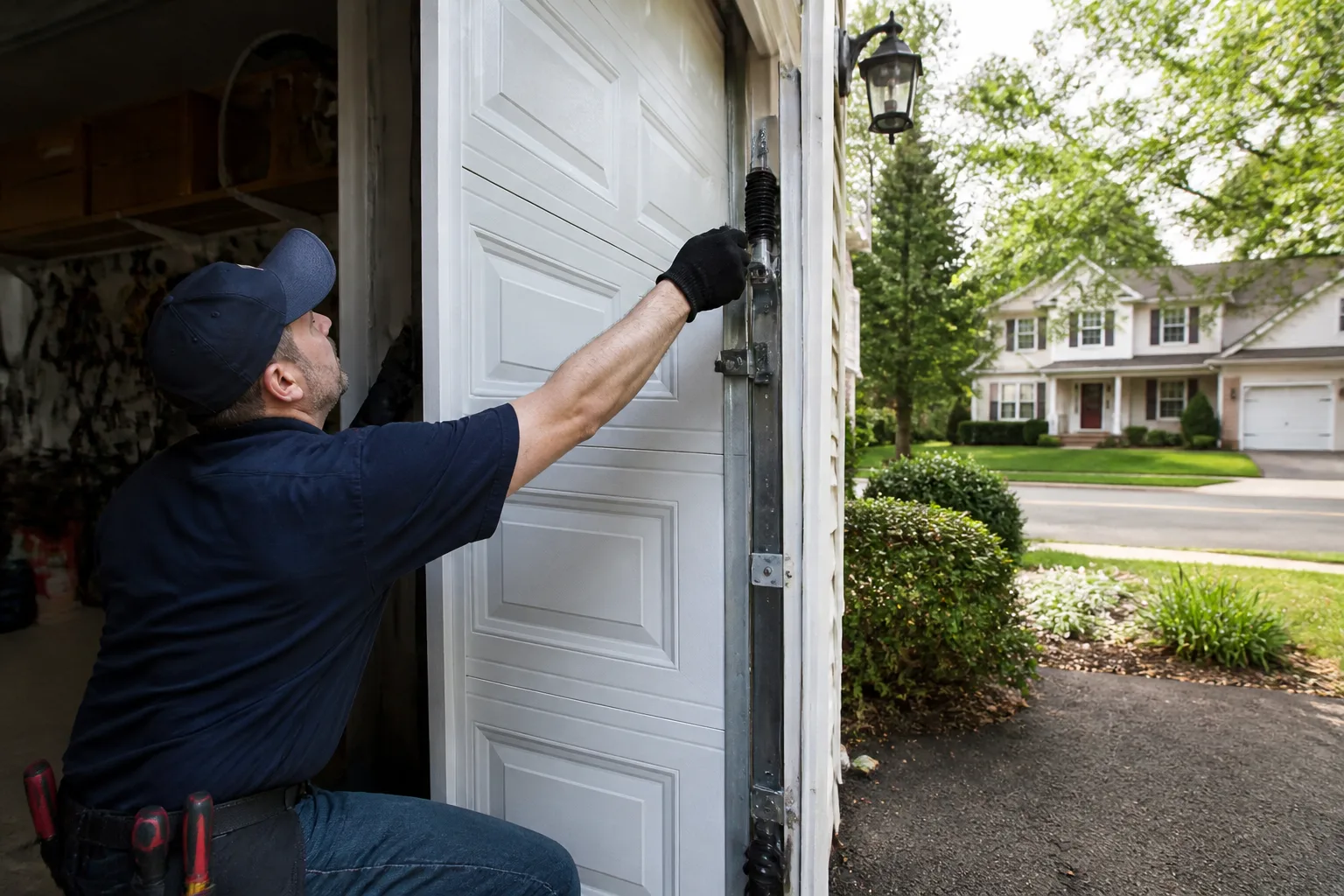
A word on springs, because it’s the one part of this system that genuinely hurts people. Garage door springs are under extreme tension, and a spring repair is not a DIY job – not with improvised tools, not with a video, not with a friend holding the other end. Spring repair is safety-critical work that belongs to trained specialists with the right tools. If your Genie opener is struggling because the door itself has gone heavy, that’s a garage door spring repair issue, and it’s worth having it looked at before the opener’s motor pays the price for fighting a binding door.
Related services in Brentwood: if you’re not sure whether the problem is the opener or the door itself, our team handles both. See garage door repair for the full diagnostic picture, or start with Brentwood Garage Door Repair Pros to see what we cover.
The Bottom Line
Genie openers are reliable machines, and a surprising share of “my opener is dead” calls trace back to something a homeowner could have spotted – a blink code pointing to a sensor issue, a remote that needed a two-step reset, travel limits that drifted out of calibration. The point of this guide is to put that knowledge in your hands so you can describe the problem accurately and recognize when a technician is on the right track versus guessing.
The Genie-specific patterns worth remembering:
- Blink codes are diagnostics. Count them and find your model’s chart.
- SilentMax speed problems are usually calibration or door friction, not a bad motor.
- Intellicode pairing failures usually need a memory clear before re-pairing.
- Genie sensors align differently from other brands – brand-matched advice matters.
- Some parts are quick to source, some aren’t. Knowing which helps you plan.
And when the DIY route runs out – a spring, a recurring sensor fault, a door off its track – that’s when to bring in a specialist. We’re a single-trade garage door specialist, not a handyman service, and Genie is one of the brands our technicians know inside and out. If you’re in Brentwood and need help, Brentwood Garage Door Repair Pros offers free estimates – call (833) 348-8658. The price is quoted and agreed before any work starts, so there are no surprises on the invoice.
Frequently Asked Questions
Most Genie repair work is quoted per job after a free estimate, and the written estimate sets the final price before any work begins. Remote and sensor fixes are typically on the lower end; opener component repairs sit higher. Call (833) 348-8658 for an exact quote – estimates are free.
Same-day service is often possible for repair calls, and a door stuck open is a priority because your home isn’t secure. Call (833) 348-8658. We answer 24/7. Fast dispatch from 7am to 7pm, Sunday through Friday. A call outside dispatch hours is booked into the next opening.
No. The estimate is written and agreed before any work starts, and the price it sets is the price. If the diagnosis reveals a different part than expected, you’ll hear about it before we proceed – not after the work is done.
The local professional who comes to your door is licensed and insured as their state requires. Our technicians have up to 9 years of experience and are certified on Genie, LiftMaster, Chamberlain, and Clopay equipment. Call (833) 348-8658 with your model number and blink code for a fast, accurate diagnosis.
Written by the team at Brentwood Garage Door Repair Pros.
Need Garage Door Help?
Call Brentwood Garage Door Repair Pros - the local pro we connect you with is licensed and insured, here with fast help in Brentwood.
(833) 348-8658